Atlas
Registry and lineage
Every agent with its owner, models, tools and data scopes. Lineage from dataset to agent to output, with impact analysis.
Platform · Enterprise Control Plane
ThoughtShieldAI sits between your agents and your models. Atlas knows what exists, Nexus enforces policy and routes approvals to a named owner, and Pulse prices every token.
 Simulated data
The problem
Each business unit ships its own agents on its own models. Nobody holds the full list, policies live in slide decks, and the first sign of a runaway workflow is the monthly invoice.
Which agents exist, who owns them, which data they read and which models they call is spread across teams and tickets.
Data residency and PII rules are written down but not checked at the moment an agent sends a payload to a model.
Spend arrives as one provider bill. Tracing a spike back to the workflow, agent and tool that caused it takes days.
How it works
Lineage and telemetry come from instrumented gateways, agent SDKs, integrations and event logs. Traffic that flows through them is governed; ThoughtShieldAI does not claim to see calls that bypass them.
Agents, models, datasets and tools with owners, scopes and lineage. Impact analysis before a model is retired.
Checks every routed call against data, region, model and cost policies. Redacts, re-routes or blocks.
Exceptions go to the named owner of the data, with the evidence and the payload before and after redaction.
Human stepCost by workflow, agent, model and business unit, with budgets, forecasts and anomaly detection.
One trace ID ties the request, the policy decision, the approval and the fix together for audit.
The human approval
Reviews the redacted payload and the re-route, then signs with a typed note. The agent cannot approve its own exception.
The scenario
The hero scenario from the live demo, step by step. Northwind Holdings is a fictional tenant with 40 agents across Finance, HR, Customer Service and Supply Chain.
01
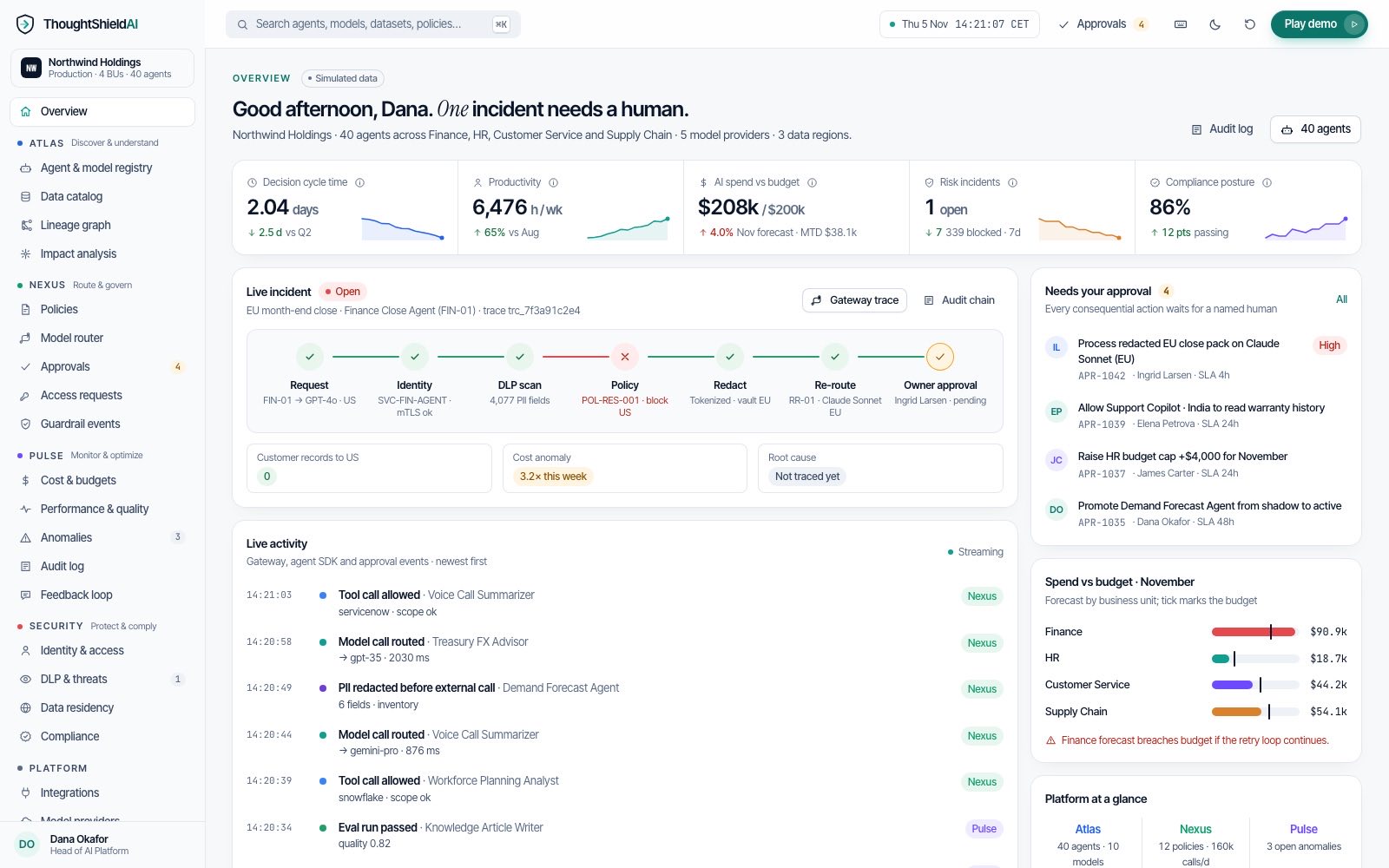
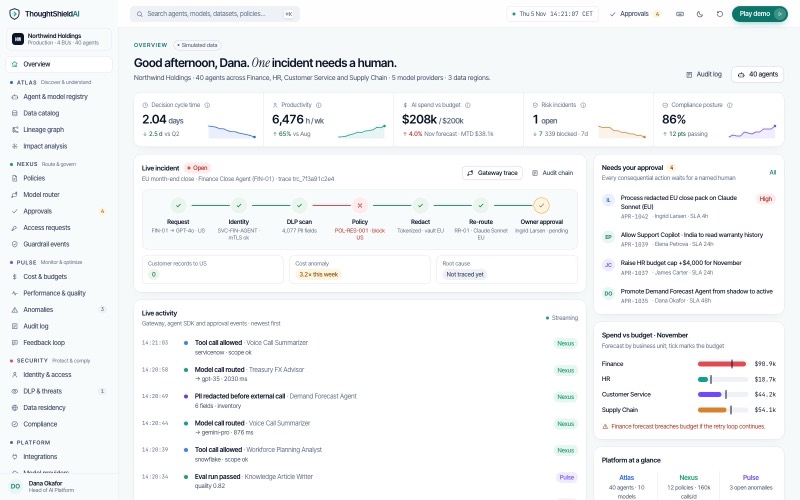
Outcome KPIs, spend against budget by business unit, and a queue of decisions waiting on a named human. One live incident is open.
 Simulated data
0214:18
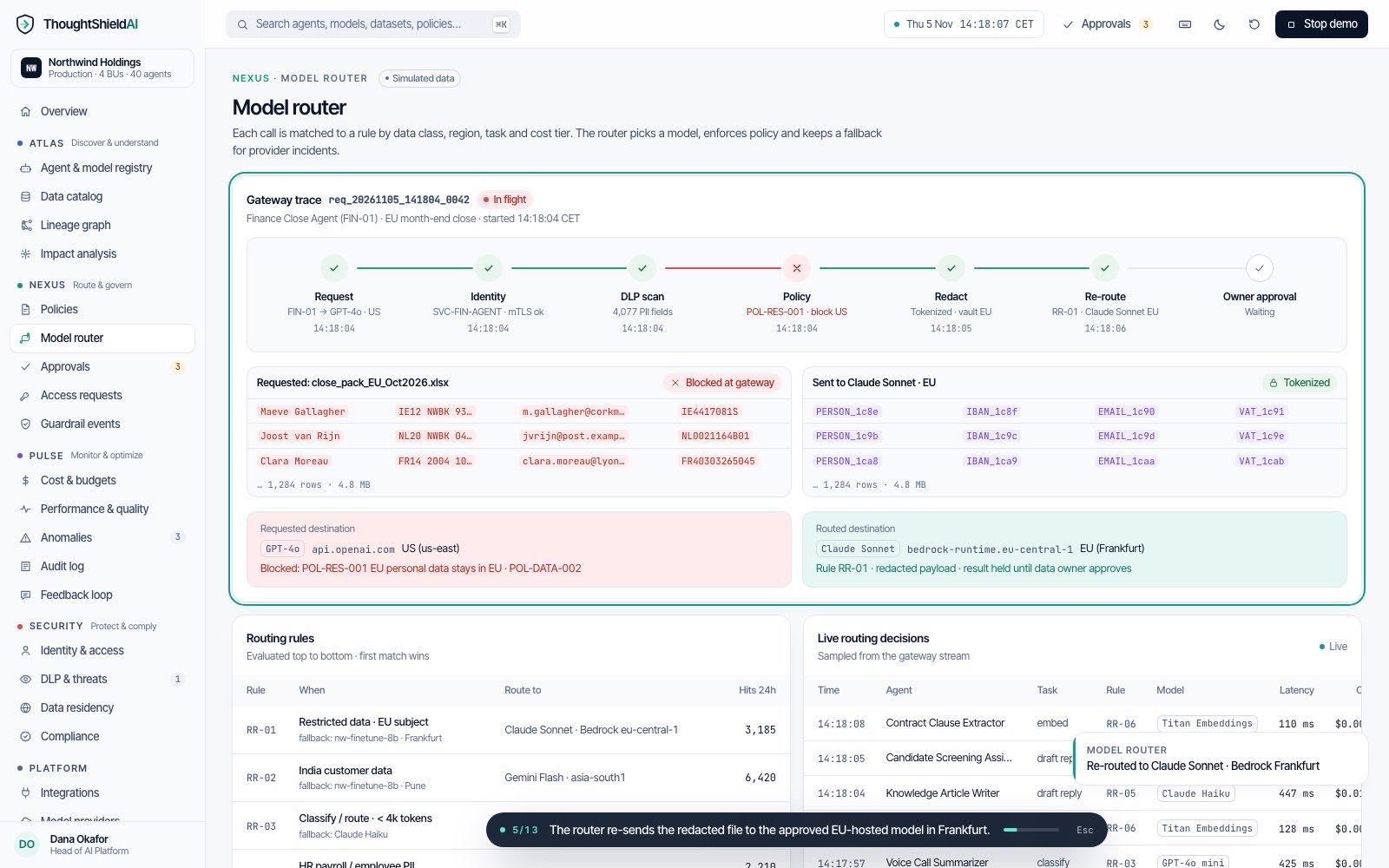
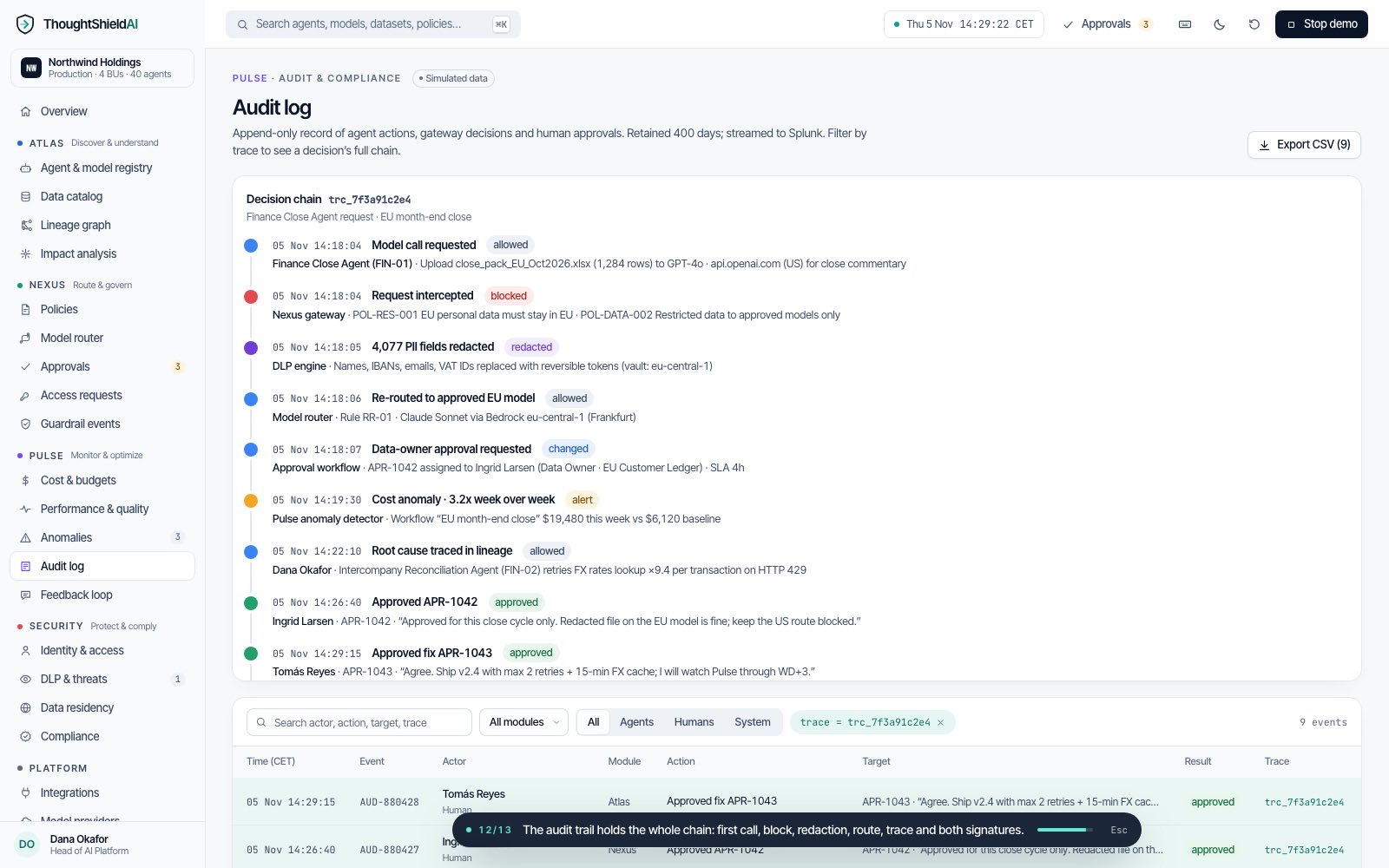
The Finance Close Agent tries to send close_pack_EU_Oct2026.xlsx (1,284 EU customer rows) to a US-hosted model. Policy POL-RES-001 blocks it, DLP tokenizes 4,077 PII fields, and rule RR-01 re-routes the redacted payload to an EU region.
Simulated data 03
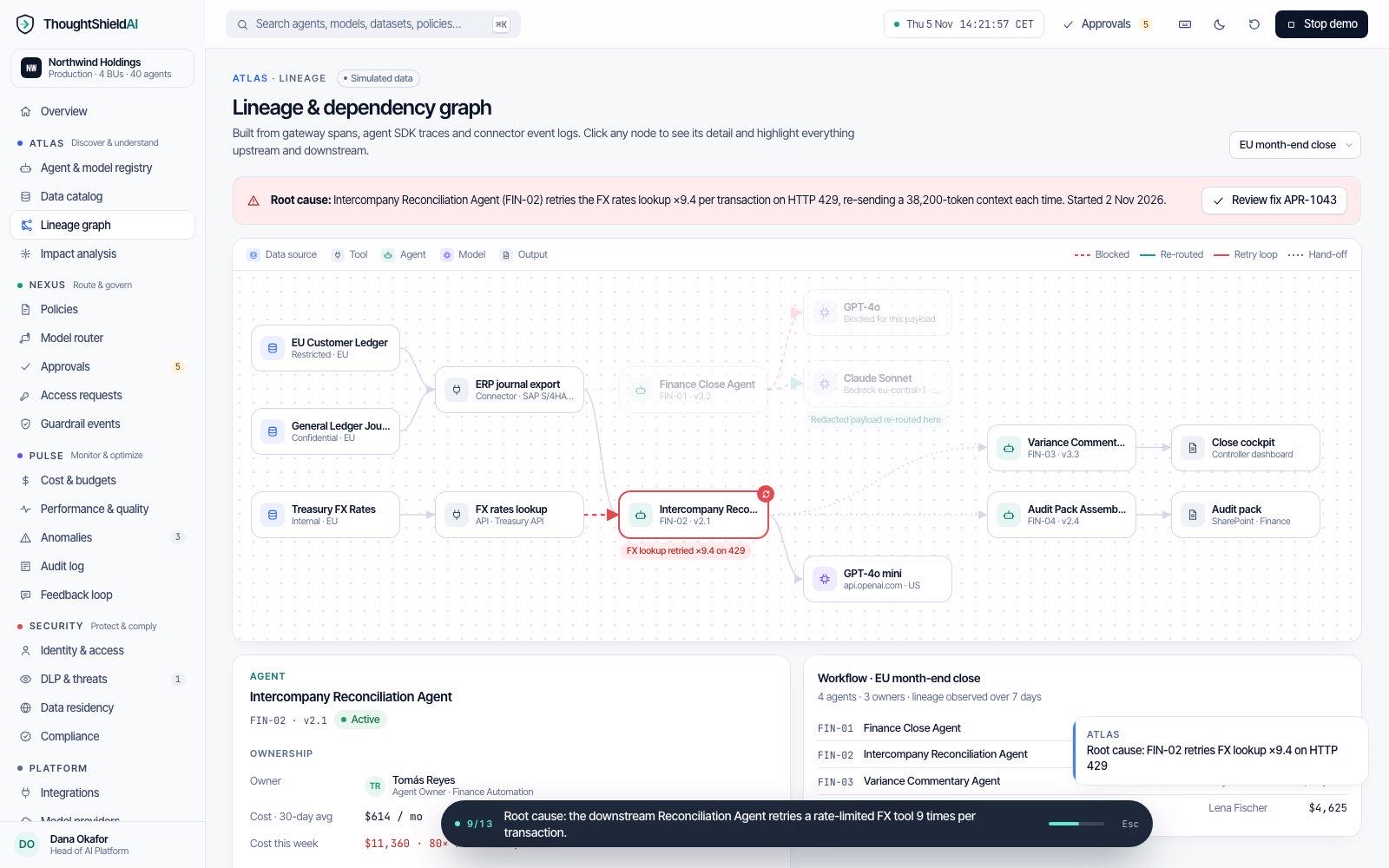
The EU month-end close costs 3.2× its baseline this week ($19,480 against $6,120). Atlas lineage traces it to a downstream reconciliation agent retrying a rate-limited FX tool 9.4 times per transaction.
 Simulated data
04
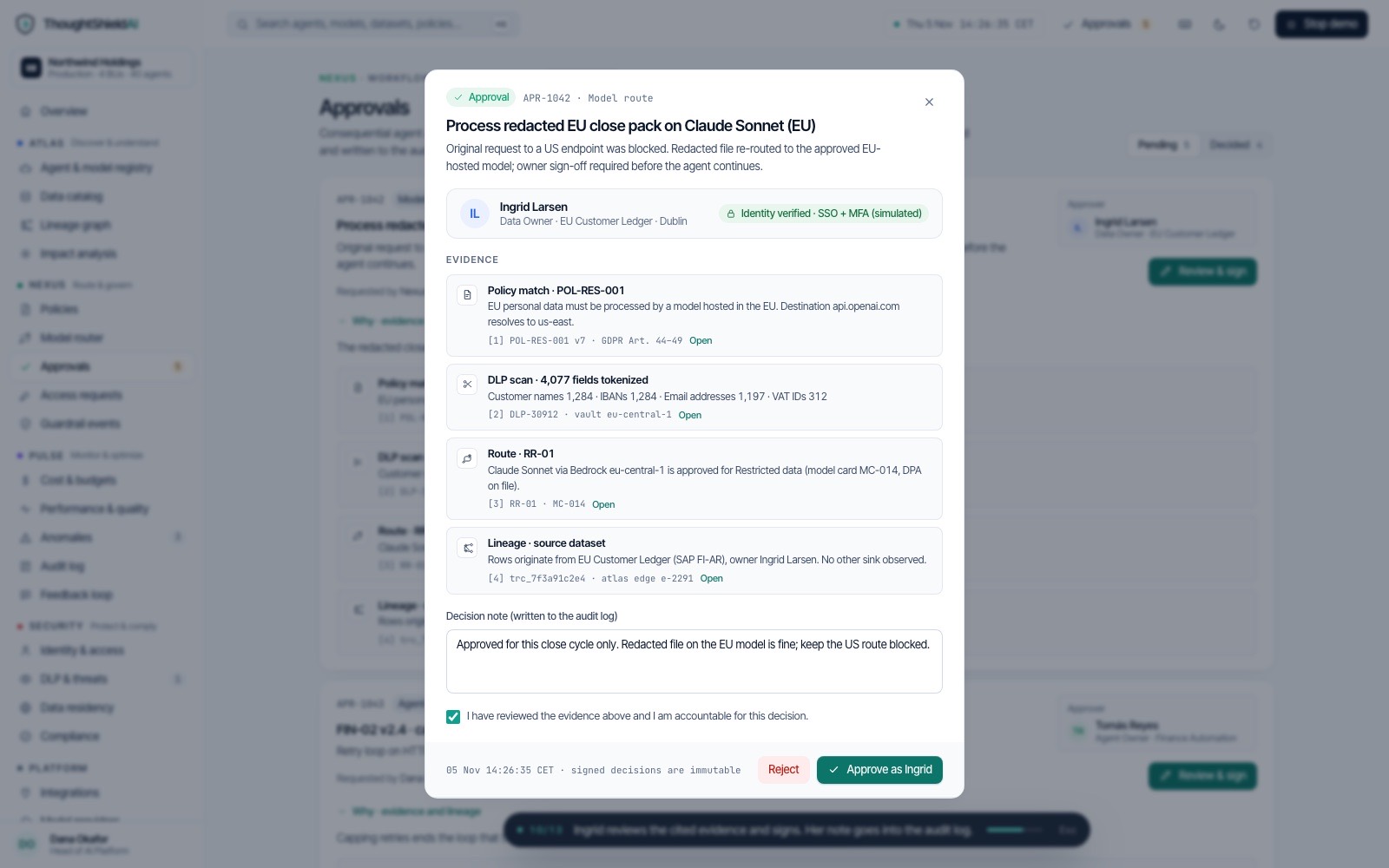
Ingrid Larsen, the data owner, opens the evidence and approves the re-route. Tomás Reyes, the agent owner, approves the fix: cap retries at 2 and cache FX rates for 15 minutes.
 Simulated data
05
The audit log, filtered to trace trc_7f3a91c2e4, shows the request, the policy decisions, both approvals and the fix in order.
 Simulated data
Governance and lineage
The decision chain behind this scenario, as ThoughtShieldAI records it. Each step can be opened in the live demo.
EU Customer Ledger extract, 1,284 rows (Atlas catalog: confidential, EU residency)
Finance Close Agent drafts the close pack and requests GPT-4o (US endpoint)
Nexus blocks, redacts and re-routes; Pulse links the cost spike to the reconciliation agent
Ingrid Larsen signs APR-1042; Tomás Reyes signs fix APR-1043
Close pack generated in-region; retries capped; trace trc_7f3a91c2e4 closed
Atlas
Every agent with its owner, models, tools and data scopes. Lineage from dataset to agent to output, with impact analysis.
Nexus
Residency, PII, model allow-lists and cost ceilings are evaluated on each routed call. Exceptions route to the named data owner.
Pulse
Budgets and forecasts per business unit; anomalies arrive with the evidence that explains them.
Security
Hash-chained audit log, DLP events, IAM drift and an EU / US / India residency view. Compliance mapping is shown as illustrative.
Live demo
The full Enterprise Control Plane app runs right here, offline, with simulated data. Press Play demo for the guided scenario (about 76 seconds), or click around freely. Reset is in the top bar.
Designed for screens 1280 px and wider. On a phone it opens full screen.
Outcomes
SimulatedSimulated outcomes from the demo scenario. Not a customer result.
No. It governs traffic that passes through its gateway, agent SDKs and connected integrations, and reads event logs you connect. Calls that bypass those paths are not seen, and the registry shows which agents are instrumented.
The design is provider-agnostic: hosted APIs, cloud model gardens and self-hosted models sit behind the same routing rules. The demo shows OpenAI, Anthropic, Google Vertex, AWS Bedrock and a self-hosted model as an illustration.
A named person set by policy, usually the owner of the data or the agent. Approvals carry the evidence, a typed note and the approver identity, and agents cannot approve their own work.
No. The tenant, people, agents and figures are fictional and deterministic. It runs offline and identically every time.
A 30-minute walkthrough of the live demo, then a conversation about the agents, data and approvals in your environment.
Opens an email to hello@anvevoice.app